Saturday, November 11, 2023

FarCry 5: Early Impressions

Having abandoned FarCry 6, I've immediately jumped into the predecessor, FarCry 5. I've noticed that this one was much better received critically, and from the initial setup, I am impressed at how well it is put together. I am also, frankly, astonished that a game that frames white American Christians as the villains managed to be published and sold so well at this moment in time. 


FC5 was released in 2018, and was developed by the Canadian Ubisoft studios in Montreal and Toronto. This is probably key to the setup of the game--I truly struggle to imagine an American studio maintaining support for this particular villain. 

Imagine for a moment if Joseph Smith had founded his church in 2000 rather than 1830, and happened to have been in Montana rather than Utah. Perhaps his last name would have been 'Bundy' or 'Koresh' in this case (In the film he'd be played by Jared Leto), and his followers would have combined their religious zealotry with a radical anti-authoritarian perspective on the Federal government.  Indeed, the game opens with a US Marshal and his deputy (the player character) serving a warrant to the Eden's Gate leader, Joseph Seed. Subsequently, of course, the extraction goes extremely sideways, and the helicopter carrying the local sheriff, deputies, the marshall, the player and Seed crashes. This sets up the initial "on your own" situation that FarCry games depend on. 

From what little specific reading I have done about this specific game, it seems that the game (and it's developers) try to walk that same line of creating a very obvious, specific social commentary, while also not actually making a point that might offend parts of their potential market. Critics have been fairly harsh in describing the 'easily digestible evil' of the Eden's Gate members, but I am not seeing it, so far. To be clear, this game is not subtle, or particularly sophisticated as yet. However, when I think of the current batch of real-world radicals such as the Bundy family, Enrique Tarrio, Thomas Ryan Rousseau, and even certain members of the US House of Representatives, I fail to see the aspect of the Eden's Gate that they would find entertaining to gun down. That is, these Christo-facsists seem awfully familiar to me in the current moment. I have a hard time imagining a member of Patriot Front going home after a tiki-illuminated race-rally, and getting their kicks by gunning down the folks who took over Hope County, Montana. 


We shall see how the game pans out. Perhaps the caricature of evil will become too silly to take seriously - but I sort of feel like what we're experiencing in reality is almost beyond parody anyway. 

Thursday, November 9, 2023

Far Cry 6: Nope

I've battled through several hours with the game, hit level 6, gathered a number of new weapons, cosmetics and trinkets, advanced the story quite a bit, taken out various installations and checkpoints, but I am just not feeling this game. 

I noticed the slapdash approach to the instigating plot in my previous post, and thus far, there were no interesting flashbacks or other methods for filling me in on the origin of the Viviro which they are spraying on the tobacco. I'm still not sold on the economics of the situation either - if the island had somehow stumbled on a general-purpose cancer cure, then the streets would be lined with gold. That isn't to say there couldn't be some kind of serious oppression going on, but I have a hard time buying the story I'm being sold. 

There was another aspect that jumped out at me: as the game tries to justify all the "busy work" necessary in a modern Ubisoft game, one of the main quest giver characters (Juan Cortez) says something to the effect of a guerilla needing to have a certain style, needed to live a certain way. Again, I just don't buy it. He's trying to sell a revolutionary "lifestyle" to Dani, and to the player, so we'll want to spend lots of time customizing our outfit, weapons, and cars. It feels almost verbatim lifted from a Grand Theft Auto game, but you just can't swap out "gangbanger" with "revolutionary guerilla" and have it come across the same. Revolutionary militia aren't believable when worrying about customizing their look - theirs is not a permanent, ongoing lifestyle, the way a gang member's might be. 

Anyway, story aside, the gameplay loop has been well and truly established early on, and it isn't enough to hold my attention for the many more hours that are going to be required to finish this thing. Speaking of mechanics, I also find the "Supremo" to be utter hogwash. Not just unbelievable in terms of a series of tubes strapped to one's back suddenly containing heat-seeking rockets, but it's also a "press to win" button of sorts that I felt really detracted from the experience. 

Sunday, November 5, 2023

Far Cry 6: First Look

I recently started FarCry 6 after having not played an FC game for many years. I am more an Assassin's Creed aficianado, although Valhala didn't resonate with me. Both games are developed and published by Ubisoft, and I honestly hadn't realized how much crossover in mechanics had occurred between the two franchises. 

Getting started in FC6 follows a pretty familiar "new action game" pattern of throwing you into a high stakes escape/chase through a part of the map that you won't return to for quite some time. I wasn't able to completely comprehend exactly why the antagonist of the game (voiced and modelled after Giancarlo Espisoto) was quite so... antagonistic. The opening cut scenes move very quickly through explaning that the faux-Cuba has discovered a "cancer drug" that is made by spraying some kind of poisonous red fog over otherwise normal tobacco. 

Understanding where this discovery was made in this otherwise third-world country is a bit of a stretch, but the real confusion for me is that if this tobacco-based cancer treatment really worked, then a country like Yara would be absolutely rolling in cash. The island would be more Wakanda and less rock-bottom Cuba. Following from this, there would simply be no reason for El Presidente to mistreat his people so badly. Why would we be using rickety old technology, and spraying the fields with dubious chemicals from crop dusters, if we were selling cancer-curing tabacco to the entire world? 

As mentioned above, there is a lot of back and forth between this Far Cry and, for example, Assassin's Creed: Odyssey. This is more particular than the generic premise of open world, hundreds of objectives to destroy, find, liberate etc. We encounter such familiar concepts as battling with specific alpha animals in hunting side quests. I am also surprised at the extent of collectibles and cosmetic customization that has developed - again, similar to Assassin's Creed. There is also a strong emphasis on finding the high ground to scout out locations prior to attacking or infiltrating them - very familiar to me from the various Assassin's Creed titles. 

I wonder about Ubisoft's other major open world franchise: the Tom Clancy series (particularly The Division). How similar is the setup in these games? Perhaps I'll have to find out sometime soon. 

Wednesday, October 25, 2023

Lies all the way down

 A while ago, I wrote and published a peer-reviewed article about the "curious" and very deliberate efforts by the developers of certain games to proclaim that their games shouldn't be interpreted in a political way, despite all evidence to the contrary. The abstract goes like this: 

Developers of AAA videogames which feature recognizable military forces, governmental law enforcement agencies, and geopolitical conflicts routinely make claims that their works do not make “political statements.” This article takes seriously the claims made by several developers, revealing their attempts to radically narrow the definition of the term “political.” Through a critical discourse analysis, this article will articulate several key theses held forth by the developers regarding systemic media and expressivity, the responsibility of the player, and the inevitable constraints of production and technology. These points are deployed by the developers to build an argument for a reduced scope of the term “political,” as well as to propose an ideological framing of videogames as an expressive medium, which ultimately serve to obscure the role that ideology plays in the production of videogames. (Ruch, 2021)  https://www.tandfonline.com/doi/full/10.1080/22041451.2021.1902167  

I say "curious" because in the end, it is clear why developers would avoid endorsing any particular interpretation of their game: because publishers they are beholden to (and to some extent, the developers themselves) want to continue selling games to as wide an audience as possible, and there is no quicker way to alienate those paying customers than by making any kind of statement that could be construed as "political." 

So, what we have to deal with is the developer of a game about retaking Washington D.C. from a band of terrorists claiming that their game is about "exploring a new city." 

It's asinine. 

When I wrote the article, I felt like I might have been scratching the surface of something important. I took a videogame and media studies on-ramp to this freeway of the bigger topic: lying. Just straight up, unadulterated fabrication surrounding us, constantly. 

These years later, I feel that this tendency has only increased. Modern media (and society as per our mediation of it) is positively lousy with untruth. 

Surely none of this is particularly shocking in the general principle - we've theorized about misinformation and researched propaganda for... ever. However, I do feel that we have recently gotten closer to a tipping point, where at least some of our most heinous liars are being called into court, where it is still against the actual law to lie, and are being asked to explain themselves. 

This is all well and good, but what about the zealous believers? Those who will not be convinced that the sky is blue, the Earth is round, and Biden is President? 

 I keenly remember the proclomations of the dawn of democratized communication that the internet supposedly heralded. We bespeckled, obsessive nerds could finally reach out and connect with those few others who shared our interests, all around the world. Queer folks, racial minorities, and other marginalized groups were able to connect without regard to geography. But, unfortunately, so could those Flat-Earthers whose beef was with geography itself. 

Now we pump those folks full of self-confidence and validation on a grand scale. It's alarming, to say the least, to realize just how pervasive lies have become. 

Sunday, August 5, 2018

Pleasure in Conveyor Belt Games

Over on CapsuleCrit, Kavi Duvvoori explores their particular and somewhat ambivalent pleasure taken in 'extractive captialist' games such as the Rollercoaster Tycoon series and Factorio. In the article, Duvvoori highlights two of the central pleasures videogames tend to feed on, neither of which are the adrenaline-pumping, conflict-oriented "competition" that one might typically associate with games in general, and videogames in particular.

Instead Duvvoori highlights a curiosity to discover "what happens if...?" given a certain level of mastery over the game. These sorts of games require/allow the player to construct elaborate (or simple) chains of cause and effect, which shuffle entities (in most cases, paying patrons, as in Rollercoaster Tycoon or Theme Hospital, for example), from beginning to end. The general idea is to extract value from those customers. In Factorio, the metaphor is more industrial: construct vast networks of literal assembly lines which add and modify components in an ever-increasing network.

I'd suggest the "what happens if?" question arises in the mind after a certain point of mastery. The initial questions are usually more like "how do I [do something specific]?" The game usually requires a certain level of proficiency in order to make the machine work at all, so players will typically have a series of smaller, more concrete goals which create a self-sustaining assembly that accepts whatever input is available, and creates a positive feedback loop more or less ad infinitum.

Often, these games will offer a wide array of objects whether rides and attractions, as in Rollercoaster Tycoon, or resource gathering and production equipment, as in the Anno series (trade routes being nautical production lines). These give the player a fixed goal to aim towards on the way to learning the basics of the system. The key is to combine these in such a way that they create more than the sum of their parts. Whether we term this resonance or positive feedback, the goal is to multiply value exponentially.

However, I feel that those numbers of imagined value are a skin over the top of the more primal pleasure of figuring out how a gadget works, then setting up ever-increasingly complex versions of that gadget to manipulate. The pleasure comes not only from setting and meeting goals, but from something primordial in humans - the same itch that is scratched by watching a ridiculous, convoluted and pointless Rube Goldberg machine work successfully. We needn't justify them in any other way than to say it feels good to build something that works.

Saturday, August 4, 2018

Warcraft Time

World of Warcraft is ... well it's a game because they sell it at game shops, and you 'play' it. But it is also a virtually interminable social space in which people interact in competitive, cooperative, and myriad other ways. To put it simply people spend time there, together.

The most recent expansion has been controversial for a number of reasons, but this article stood out to me. In it, James Whitbrook describes an unexpected melancholy that was immediately recognizeable to me. I wonder how many other players have experienced the dawning realization of real, mortal time passing based on milestones in that game. I wrote about mine years ago, when I learned of the one-off sale of one of the original WoW servers.

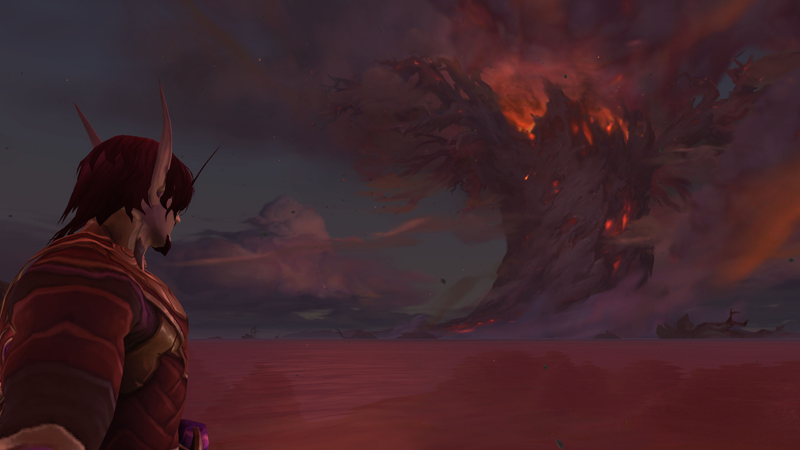
These years later, I've had similar feelings of nostalgia and the sensation of quiet loss that growing older brings with it; I wonder how much the association with WoW for both Whitbrook and myself is simply the context in which we've turned a corner. We've realized a new metric or scale of time. We can measure things in years - longer than high school, longer than college or that job we had in our early twenties. Yet, something has caused us to notice that the relationship we have with WoW to change. For me, the server, for Whitbrook, the burning of Teldrassil.

It would be interesting to compare these anecdotes to the players of professional sports. Someone who played basketball through high school, college and professionally. How do they relate their life to their game? Is it any different?

Wednesday, August 1, 2018

Designation of a "Gaming Disorder" by WHO

In January 2018, the World Health Organization identified a "Gaming disorder" as follows:
as a pattern of gaming behavior (“digital-gaming” or “video-gaming”) characterized by impaired control over gaming, increasing priority given to gaming over other activities to the extent that gaming takes precedence over other interests and daily activities, and continuation or escalation of gaming despite the occurrence of negative consequences.
For gaming disorder to be diagnosed, the behaviour pattern must be of sufficient severity to result in significant impairment in personal, family, social, educational, occupational or other important areas of functioning and would normally have been evident for at least 12 months.
Many in the gaming community would typically circle the wagons and defend the medium, as has occurred for decades, typically with respect to causing violent behaviour in players. The mantra has been that games have no impact on players and should not be singled out as being more effective at modifying the thoughts or behaviour of the players than any other media form.

Reading the above diagnosis carefully, however, one must focus on the explicit criteria for the disorder, specifically "despite the occurrence of negative consequences." This is not stating that playing videogames (to any particular measured extent) is a negative consequence in and of itself.  For this diagnosis to be valid, the player must be experiencing "significant impairment in personal, family, social educational, occupational or other important areas..." Meaning, then, that only when the focus on game play takes precedence over other important (necessary?) life functions does it become a problem.

My view on these matters has always been cautious scepticism. Describing videogames as having no effect on their players is tantamount to saying they are meaningless - hardly a tenable position for a media scholar to take. I've argued vehemently in the past for an R18+ rating in the Australian classification system not because I believe strongly that mature games should be restricted to adults (though I think some kind of warning or guide is certainly useful) but because such a rating would ensure mature games are not banned outright. In the Australian context, such a 'restriction' is actually a liberalisation of an already parochial system.

Though I don't agree with him on every point, Jeremy Ray proposes that such a designation by WHO is a necessary step in the maturation of the medium. He focuses in particular on the compulsion exploiting design employed by videogames, derived very clearly from the gambling industry and Skinner-type psychology.

From my limited understanding (after all I am not a medical doctor or psychologist!) it appears that the WHO designation takes a sober view of game practices. Unlike the Australian classification system which excepted videogames from the R18+ category due to their purported "higher impact" baseline, WHO appears to be focused on the relative impact on other aspects of the player's life, not on some exceptional, unique aspect of videogames themselves. This, then, is only fair.

Diablo 4: A Terminal Deficit of Soul

One knows basically what to expect when starting a new game of Diablo: archetypal role-playing game class selections, gothic Christian aesth...