Showing posts with label FarCry5. Show all posts

Sunday, December 10, 2023

Far Cry 5: An Illustrative Mess

When performing criticism of a videogame, I feel that playing it some time after its release presents certain advantages: firstly, we are removed from the marketing hype that has built up some expectations in the player, which may or may not be delivered by the game itself. Next, the game is in a more ‘complete’ state after additions, game of the year editions, and various patches are applied. Lastly, in some cases, there is a removal from the particular social moment of the game’s release which can provide a new lens through which to view the game. This three-part defamiliarization adds up to provide an interesting, and I think, beneficial perspective from which to review a game. This is not to say that this five-years-late review is the proper way to consider a game, certainly I wouldn’t preference one method above the other in absolute terms. However, in my overall pursuit to use criticism to add meaning to games rather than to provide a buyer’s guide, then I feel this approach is just as valid as any other.

Playing Ubisoft's Far Cry 5 (FC5) in 2023 is certainly an experience unlike any other. The game follows the now well-established structure of the Far Cry series which involves a discrete chunk of territory being gradually 'liberated’ from a hostile force through individual, guerilla-style tactics. The silent player-character arrives as an outsider who works with locals to unite a resistance and turn the tide on the enemy forces. In this case the “Project at Eden’s Gate” is a Christian doomsday cult whose charismatic, hipster-styled leader Joseph Seed is bent on preparing his flock for the great collapse of society. He and his three siblings (Jacob, Faith, and John) have taken violent control of the fictitious “Hope County” set in the American state of Montana. 

Hope County Regions

Before moving any farther, we must reiterate the point here: FC5 positions a group of Christian Americans, led by a quartet of white champions as the enemy. The innumerable members of the cult are not exclusively white (indeed they are perhaps a more diverse racial group than one might expect to find in a real Montana), but these enemies are definitely not presented as a brown-skinned ‘other’ with exotic characteristics and religion. Many, many games are criticized for the facile dehumanization of the enemy through that kind of race-based othering, not least of all the Far Cry series. Whatever else follows, Ubisoft published a game where a group of American Christians are the bad guys. This should not be lost. 

Thursday, December 7, 2023

Just Give Me Two Good Reasons

One of the dominant features of open-world games such as FarCry 5 is that they are big. Really big. The scale of the map is an often discussed feature of such games, but so too are the myriad activities and overall "playtime" that a game can offer. Presumably more is better, but I find myself getting bogged down if a game is too big. 

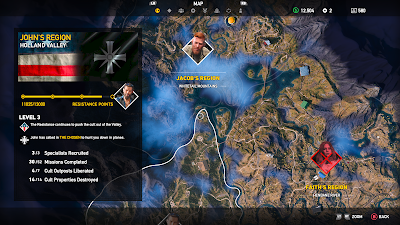
FarCry 5 follows a familiar pattern of dividing Hope County up into several regions. Three are the main areas for play, with two much smaller zones acting as introductory and concluding bookends. Each of the main three regions are controlled by one of the Eden's Gate lieutenants, and feature some gently stylized environmental features and challenges. For example, in Faith's region, the hallucinogenic 'bliss' is manufactured out of the fields of lily-like flowers found around the region. The basic mechanic is that the player character ("Rook" or "Deputy"), takes on each lieutenant in turn through a network of loosely connected 'story' and 'side' missions. They can also destroy various assets and liberate outposts in each region. 

All of this accumulates as "Resistance Points" within the given region. There are a few milestones where the game suddenly intervenes with some strong deus ex machina to advance the overarching plot. The final milestone in each region is that the lieutenant will call the player out in some way, triggering the final boss-like showdown and finally liberating the region. 

With all that exposition out of the way, I can talk about how it worked for me. I find that the story missions can really derail my enthusiasm for these games. Too much talking to minor NPCs of tremendously varied quality and interest, sending me on the archetypal errand quests of some sort or another. Even though this really is the crux of any open world game, I find myself hitting a limit pretty fast. 

What suddenly happened in FarCry 5 was that I realized there were dozens of challenges that would award my character upgrade "perks" depending on how I played. So, as I browsed the challenges, which range from killing a certain number of enemies with a particular weapon, to killing a certain number of enemies from a certain distance, I suddenly had two birds I could address with one stone (or flamethrower, dynamite, or whatever). 


These challenges are not particularly inspired nor are they unique to FarCry 5. In fact, this sort of encouragement to play the game differently based on weapons and approach is almost as ubiquitous as the open world design described above. 

I argue that it is common because it is effective. I could turn my attention more to the 'how' rather than the 'what' when I got a little bored of liberating outposts or defending territory. Instead of my usual sniper and stealth approach, I used a flamethrower up close in a wildly different playstyle. I was making two sorts of progress, then, and that was enough to get my over a certain hump in the overall game. 

As the unlocks started to trickle and then flow, I found the game easier, since not only did I have more tools at my disposal, but I also had practiced a few different techniques for dealing with the game's challenges. That helped me progress faster, which was the problem in the first place. 

This layering of incentives is a crucial element to longer games. Personally, I'd like to see this design feature extrapolated outside of videogame design. The area I always think of is education. How can we make the incentives more varied and explicit in the years-long process of getting a degree? Is there a way we can help students not endure but enjoy the various challenges we throw at them? 
Saturday, November 11, 2023

FarCry 5: Early Impressions

Having abandoned FarCry 6, I've immediately jumped into the predecessor, FarCry 5. I've noticed that this one was much better received critically, and from the initial setup, I am impressed at how well it is put together. I am also, frankly, astonished that a game that frames white American Christians as the villains managed to be published and sold so well at this moment in time. 


FC5 was released in 2018, and was developed by the Canadian Ubisoft studios in Montreal and Toronto. This is probably key to the setup of the game--I truly struggle to imagine an American studio maintaining support for this particular villain. 

Imagine for a moment if Joseph Smith had founded his church in 2000 rather than 1830, and happened to have been in Montana rather than Utah. Perhaps his last name would have been 'Bundy' or 'Koresh' in this case (In the film he'd be played by Jared Leto), and his followers would have combined their religious zealotry with a radical anti-authoritarian perspective on the Federal government.  Indeed, the game opens with a US Marshal and his deputy (the player character) serving a warrant to the Eden's Gate leader, Joseph Seed. Subsequently, of course, the extraction goes extremely sideways, and the helicopter carrying the local sheriff, deputies, the marshall, the player and Seed crashes. This sets up the initial "on your own" situation that FarCry games depend on. 

From what little specific reading I have done about this specific game, it seems that the game (and it's developers) try to walk that same line of creating a very obvious, specific social commentary, while also not actually making a point that might offend parts of their potential market. Critics have been fairly harsh in describing the 'easily digestible evil' of the Eden's Gate members, but I am not seeing it, so far. To be clear, this game is not subtle, or particularly sophisticated as yet. However, when I think of the current batch of real-world radicals such as the Bundy family, Enrique Tarrio, Thomas Ryan Rousseau, and even certain members of the US House of Representatives, I fail to see the aspect of the Eden's Gate that they would find entertaining to gun down. That is, these Christo-facsists seem awfully familiar to me in the current moment. I have a hard time imagining a member of Patriot Front going home after a tiki-illuminated race-rally, and getting their kicks by gunning down the folks who took over Hope County, Montana. 


We shall see how the game pans out. Perhaps the caricature of evil will become too silly to take seriously - but I sort of feel like what we're experiencing in reality is almost beyond parody anyway. 

Diablo 4: A Terminal Deficit of Soul

One knows basically what to expect when starting a new game of Diablo: archetypal role-playing game class selections, gothic Christian aesth...