World of Warcraft is ... well it's a game because they sell it at game shops, and you 'play' it. But it is also a virtually interminable social space in which people interact in competitive, cooperative, and myriad other ways. To put it simply people spend time there, together.
The most recent expansion has been controversial for a number of reasons, but this article stood out to me. In it, James Whitbrook describes an unexpected melancholy that was immediately recognizeable to me. I wonder how many other players have experienced the dawning realization of real, mortal time passing based on milestones in that game. I wrote about mine years ago, when I learned of the one-off sale of one of the original WoW servers.
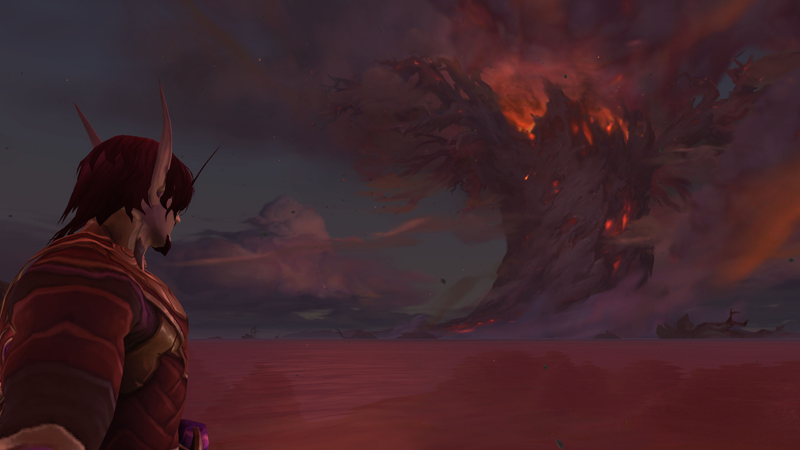
These years later, I've had similar feelings of nostalgia and the sensation of quiet loss that growing older brings with it; I wonder how much the association with WoW for both Whitbrook and myself is simply the context in which we've turned a corner. We've realized a new metric or scale of time. We can measure things in years - longer than high school, longer than college or that job we had in our early twenties. Yet, something has caused us to notice that the relationship we have with WoW to change. For me, the server, for Whitbrook, the burning of Teldrassil.
It would be interesting to compare these anecdotes to the players of professional sports. Someone who played basketball through high school, college and professionally. How do they relate their life to their game? Is it any different?
Saturday, August 4, 2018
Wednesday, August 1, 2018
Designation of a "Gaming Disorder" by WHO
In January 2018, the World Health Organization identified a "Gaming disorder" as follows:
Reading the above diagnosis carefully, however, one must focus on the explicit criteria for the disorder, specifically "despite the occurrence of negative consequences." This is not stating that playing videogames (to any particular measured extent) is a negative consequence in and of itself. For this diagnosis to be valid, the player must be experiencing "significant impairment in personal, family, social educational, occupational or other important areas..." Meaning, then, that only when the focus on game play takes precedence over other important (necessary?) life functions does it become a problem.
My view on these matters has always been cautious scepticism. Describing videogames as having no effect on their players is tantamount to saying they are meaningless - hardly a tenable position for a media scholar to take. I've argued vehemently in the past for an R18+ rating in the Australian classification system not because I believe strongly that mature games should be restricted to adults (though I think some kind of warning or guide is certainly useful) but because such a rating would ensure mature games are not banned outright. In the Australian context, such a 'restriction' is actually a liberalisation of an already parochial system.
Though I don't agree with him on every point, Jeremy Ray proposes that such a designation by WHO is a necessary step in the maturation of the medium. He focuses in particular on the compulsion exploiting design employed by videogames, derived very clearly from the gambling industry and Skinner-type psychology.
From my limited understanding (after all I am not a medical doctor or psychologist!) it appears that the WHO designation takes a sober view of game practices. Unlike the Australian classification system which excepted videogames from the R18+ category due to their purported "higher impact" baseline, WHO appears to be focused on the relative impact on other aspects of the player's life, not on some exceptional, unique aspect of videogames themselves. This, then, is only fair.
Many in the gaming community would typically circle the wagons and defend the medium, as has occurred for decades, typically with respect to causing violent behaviour in players. The mantra has been that games have no impact on players and should not be singled out as being more effective at modifying the thoughts or behaviour of the players than any other media form.as a pattern of gaming behavior (“digital-gaming” or “video-gaming”) characterized by impaired control over gaming, increasing priority given to gaming over other activities to the extent that gaming takes precedence over other interests and daily activities, and continuation or escalation of gaming despite the occurrence of negative consequences.For gaming disorder to be diagnosed, the behaviour pattern must be of sufficient severity to result in significant impairment in personal, family, social, educational, occupational or other important areas of functioning and would normally have been evident for at least 12 months.
Reading the above diagnosis carefully, however, one must focus on the explicit criteria for the disorder, specifically "despite the occurrence of negative consequences." This is not stating that playing videogames (to any particular measured extent) is a negative consequence in and of itself. For this diagnosis to be valid, the player must be experiencing "significant impairment in personal, family, social educational, occupational or other important areas..." Meaning, then, that only when the focus on game play takes precedence over other important (necessary?) life functions does it become a problem.
My view on these matters has always been cautious scepticism. Describing videogames as having no effect on their players is tantamount to saying they are meaningless - hardly a tenable position for a media scholar to take. I've argued vehemently in the past for an R18+ rating in the Australian classification system not because I believe strongly that mature games should be restricted to adults (though I think some kind of warning or guide is certainly useful) but because such a rating would ensure mature games are not banned outright. In the Australian context, such a 'restriction' is actually a liberalisation of an already parochial system.
Though I don't agree with him on every point, Jeremy Ray proposes that such a designation by WHO is a necessary step in the maturation of the medium. He focuses in particular on the compulsion exploiting design employed by videogames, derived very clearly from the gambling industry and Skinner-type psychology.
From my limited understanding (after all I am not a medical doctor or psychologist!) it appears that the WHO designation takes a sober view of game practices. Unlike the Australian classification system which excepted videogames from the R18+ category due to their purported "higher impact" baseline, WHO appears to be focused on the relative impact on other aspects of the player's life, not on some exceptional, unique aspect of videogames themselves. This, then, is only fair.
Monday, July 30, 2018
Everything Old is New
Who starts a blog in 2018, seriously?
An academic hitting RESET on his writing, of course!
I am looking forward to redeveloping my critical voice, here and elsewhere, and participating once again in the discourse around games, interactive media and pop culture more generally. These things start slowly, of course, so this is not a promise of daily or even weekly updates, though I certainly have ambitions presently.
In the near term I intend to draft out a few ideas that may spin into more thoroughly-researched articles or conference presentations. I may also write pieces with a broader appeal specifically for posting here and cross-posting to other platforms.
So, wish me luck and hopefully this is not both the first and last post on this here website.
An academic hitting RESET on his writing, of course!
I am looking forward to redeveloping my critical voice, here and elsewhere, and participating once again in the discourse around games, interactive media and pop culture more generally. These things start slowly, of course, so this is not a promise of daily or even weekly updates, though I certainly have ambitions presently.
In the near term I intend to draft out a few ideas that may spin into more thoroughly-researched articles or conference presentations. I may also write pieces with a broader appeal specifically for posting here and cross-posting to other platforms.
So, wish me luck and hopefully this is not both the first and last post on this here website.
Sunday, January 13, 2013
Arma 2 Wasteland: Development vs Design
Original Post: Jan 13 2013
Let's talk a little about game design. As a researcher and teacher, I sometimes find it difficult to express in words exactly what it is that game design is, or what I hope to teach to outsiders--even to gamers themselves sometimes. Capturing exactly what the difference is between design decisions and development process is difficult, since "good" design often fades into the background because it just works. As a player, one rarely notices all the individual rules and decisions that have been made, the experience occupies the conscious mind.
Discussing game design is difficult because it is a second-order task. A designer constructs the rules, environment, etc. but always in hopes that the player will experience something that is greater than the sum of those parts. When set in motion, the player(s), rules, environment and fiction all combine and create something that is not obviously discernible from a list of the game's rules. Further, since it is the player whom we as designers are trying to affect somehow, their perception and personal interpretation of what is happening is more important than what the game design document says should be the result. (Not that players can't be wrong or ignorant, but we still have to deal with their perception of our work.)
Finally, discussing the design of the kinds of games I like is very difficult, because there is very little opportunity for experimentation to verify any hypotheses about the way the game works. That is, I'm not often able to change one rule and see how it plays out. The games are sealed and finished, I can't tamper with them myself very often. Even in franchise games such as Assassin's Creed or Mass Effect, which are largely similar, many changes have been made between iterations, so it becomes difficult to nail down exactly what cause has led to which effect.
For these reasons, I've been excited by the learning opportunities I've had while playing the latest post-DayZ Arma mod to sweep the Internet: Wasteland. In general, Wasteland is much like DayZ: a semi-persistent, on-going mission set in Chernarus (or other maps now) where players must contend with each other, as well as manage a hunger/thirst mechanic. There are no zombies in Wasteland, only players. Much higher-grade weapons are generally available than in DayZ, mostly found in the trunk of the many vehicles which randomly spawn throughout the settlements. So Wasteland is, broadly speaking, a very large, variably-paced deathmatch. There are 3 factions, BluFor, OpFor and Independents. The Op and Blu forces are designated as teams who are to work together, while Independents are free to do as they please--team up or lone wolf.
From this basic premise, each server begins to differentiate. In a digital version of "house rules" many server admins fancy themselves amateur game designers (or at least developers, more on that soon), and so start to tinker with the code that defines the Wasteland mission. These small changes ripple outward in unpredictable ways, and interact with other changes, to affect the overall experience.
From here I will explore two examples of rules which are affecting the experience on certain servers that I've been playing on. The beauty of this server situation is that I can jump between very similar games, and compare the two sets of rules in a much more "controlled" experimental way than is possible in many other games.
The first issue is really more of a problem than an example of a rule-change between servers, but serves to illustrate my point about game design. In Wasteland, players can use various kinds of building-materials to create bases. These include sniper platforms, sandbag walls, and other ready-made base buildings. Some of these items are quite large, and the mechanics whereby a single player can walk along carrying a small building around is quite ridiculous. However, the problematic aspect is that a BluFor player can pick up a ten meter-long wall, and by walking or turning it around, can kill the other players using the collision physics built into the game.
Obviously, no cooperative team mate would want to do this--but this is a game played on the internet where people are jerks, so it happens all the time. Some troll will go to the BluFor base, as a BluFor member, and simply move a base wall, killing as many of his faction as he until one of them shoots him. The issue here is that the collision physics do not track who is responsible for the deaths--the system has no way to know that it was BluFor Johnny that killed his own team. Thus, the punishment mechanic, which is a way for players killed by their own teammates using weapons to remove team-killers, doesn't work. In fact, it is the troll--once shot by BluFor--who is better equipped to punish his law-abiding teammates.
To me, this is more of a development problem or task, than a design concern. This is a sort of maintenance issue where the game is obviously not working "right." The rules that define how the game is designed to work aren't perfectly translated into computer logic, and we have a less than optimal result. That said, the rules, the design decisions, are already made: teams, base building, physics etc. We simply need to code them into the computer system better.
Finally we come to the meat of this article--a long enough build up I'm sure. Recently, one of the servers I play on has changed a few things in Wasteland. I'm going to report the situation backwards for rhetorical effect here: Users noticed the changes and started complaining. Mainly, the complaints where about the lack of vehicles in the spawn areas. People were spawning in and had to run a couple of kilometers to find a car. This was not the case as recently as last week; cars were generally easy to find. Cars, remember, also usually contain weapons. So people were complaining about being required to run around with just pistols for quite a while.
The obvious solution to this symptom is to increase the number or frequency of vehicle spawns in the game. However, this was not the actual problem. What the admin changed was where people were spawning. Players were spawning along the coast, a much narrower range of areas than previously. The result of this is that the people who spawn first get in a vehicle and drive away, die somewhere inland, and repeat. So eventually, players have organically moved all the cars that were at the coast to somewhere slightly inland. The perception was that there were fewer cars, when really the issue was that the players were moving them basically in one direction, away from the coast. Since no one was spawning inland, the cars that made it even to the first set of towns away from the coast were staying there. People weren't driving any cars from inland back out to the coast, or at least not enough to make a difference.
By changing the spawning area, the admin did not just create a vehicle shortage. Because the sixty-or-so players were all spawning in about ten locations, rather than forty or fifty, there were far more shoot-outs in those spawning locations than when the spawns were spread out. These shoot-outs were often between pistols, since very few people had any access to higher grade weapons. Secondly, they are usually fatal, so at least one of the participants respawns again on the coast, exacerbating the problem.
So, there are no vehicles on the coast, there are many players, who continue to fight, and kill each other, and respawn again on the coast. Getting inland became doubly difficult. This has another knock-on affect, impacting the experience of being inland itself. Prior to these changes, the distribution of spawn locations and the high mobility offered by vehicles led to the entire map being "in play." Unlike DayZ where certain obvious paths became well-worn between highly-valued locations, Wasteland was less predictable. One could expect an encounter at any moment, or could dig in almost anywhere and set up an ambush. After the changes, with a large percentage of the population stuck in a coastal deathmatch, the rest of the map is desolate.
I have asked, but have yet to hear a cogent answer as to the purpose of these spawn-point changes. I'm not sure what the admin was seeking to do, but I'm sure this isn't the effect he wanted. The example is illustrative though--how one change can have such dramatic impacts, and how the symptoms ("Why aren't there any vehicles anymore?!?!") do not always point to the real problem. As I said above, game design operates at one remove: you design rules, but what you want to create is play.
Tuesday, November 6, 2012
Videogames and the Gilette Model
Original Post: November 6, 2012
Lately I’ve noticed a slew of products I can buy, which will subsequently force me to buy ‘refills’ of some description, in order to keep using them. On top of this, I have noticed an increase in the number of household products which determine how and when the consumable is used, to better schedule the re-purchases. Here are a couple examples:
Dettol hand wash – dumps a precise amount of soap into your hand through the magic of infra-red sensors. Of course you can’t fill it up with any old soap…
Auto-bug and freshener sprays – two different ways to fill your house with a fine mist of chemical sprays, set to a timer to empty the can right on schedule.
Lots of cleaning supplies and body cleansers have transformed from bottles into wipes, which you run out of at a pretty steady rate. You can’t really use just ‘a little bit’ of a wet, soapy wipe the way you can use just a little bit of soap. Those cages you hang in the toilet to freshen it up operate on a similarly automatic principle, as do air or water filters.
The ‘Gillette model’ is a method of selling consumer products where the initial buy-in is very low-cost, but relies on the purchase of a complementary product which is relatively more expensive, and certainly a higher profit for the manufacturer. The most famous example is the source of its name, Gillette razor blades: you can buy the handle for your razor (with one or two blades) very cheaply. But the new blades are extremely expensive by comparison. But you must buy them, or the handle is useless, right? This isn’t all smoke and mirrors—obviously many products like disposable razors, ink-jet printer cartridges, and air fresheners need to be replaced, they are consumable. It’s the pricing model that’s important to note.
What it achieves is a more predictable, steady flow of revenue for the particular manufacturer. Since you have to buy new razor blades occasionally, if you already own a Gillette razor handle, you’re more likely to buy Gillette refills. The schedule mentioned above simply regulates this a bit. Dettol want you to buy their soap regularly, so they make sure you use a certain amount of it every time you wash your hands. The automatic freshener sprays promise to fill the air with a pleasant scent to mask odours before you even notice they are there—also they use up a can of spray like clockwork.
What the hell does potpourri spray, soap and shaving have to do with videogames??
Videogame publishers, like Gillette and SC Johnson are businesses. They want money just like any other business. Further, they’d love to have a nice predictable stream of revenue they can use to make investments and placate shareholders. As the price of development in the AAA range continues to increase, the risk of failure increases also. Publishers are searching for ways to mitigate that risk, and new financial models are one way to do so.
If a game costs two hundred million dollars to develop, and is sold in a traditional, $60-100 one-shot transaction, the risk to the publisher is huge. What if the players simply don’t buy that particular box? Even if players do buy, once they take the game home, the publisher never hears from them again. Firstly, the publishers won’t know very much about the reasons the customers did and did not spend the money. Secondly, what if some population of players was willing to spend more than the sticker price? Thirdly, once the initial rush of ‘new game release!’ purchases are over, that publisher’s revenue stream plummets to a tiny trickle until the next big release. That could be as far as two or three years away—not a good interval between pay days, I think we’d all agree.
There are a few possible answers, experiments that developers and publishers have already been trying for a number of years. The first is pretty obviously DLC: you buy the game, and then a month later shell out another few dollars to inject some fresh cash into the developer/publisher. The second is the GOTY Edition, a phenomenon that has little (or nothing) to do with critical awards, but exists merely as an opportunity to package the DLC together with the original game to perform another exercise in marketing.
In the end, though, both of these are merely repetitions of the first practice, on a smaller scale: create a game/content, fire it off into retail stores and hope.
A more fundamental change has been creeping across the videogame industry. Speaking very broadly, the goal of publishers is to avoid these big, one-off purchases which exist as a point in time. Instead, they wish to set up a dialog between game and player, a kind of ongoing conversation which is spoken with money. So, the player is continually engaged in the process of buying something, and the publisher is constantly engaged in providing whatever it is that’s being purchased. There is obviously a point at which this begins, but no clear point at which it ends. Think, for example, of buying a new MMO, and setting up a subscription. Many videogames, like air fresheners and hand soap, are transforming from a product into a service.
This kind of steady stream of revenue is far more predictable and less volatile. After launch (still a risky proposition), a publisher can observe positive or negative sales trends over time. Assuming that the launch goes well enough, the developer can try things in real time to increase subscribers, rather than wait until their next game is ready to try anything new. MMOs are currently the only genre of game to require these kinds of straight-forward subscription fees, and players expect a certain amount of content to be added to the game over time without cost. To me, this is very similar to the Gillette model described above. Buy into the game, keep on paying to access the content you are increasingly invested in.
Blizzard (and many other MMO-makers) have somehow managed to combine the box-buy (purchasing the CDs) and the subscription fee. That the initial WoW buy-in, as well as expansion packs, costs about the same as any other AAA game without the on-going fee strikes me as fairly remarkable, distinct from the cheap Gillette handle with expensive blades model. An even more precise comparison is found in ‘free to play’ videogames.
The other name for the Gillette model is ‘freebie marketing.’ That is, you can practically (or literally) give away the first chunk of whatever your product is (the handle and first blade, the first ink cartridge, first tier of gear in your RPG), and rely entirely on the steady flow of revenue that this initial buy-in encourages. Quite a lot has been said about the merits and faults of this kind of financial arrangement, I won’t repeat here. Suffice it to say that free to play videogames work to gain buy-in from their players by generating an emotional investment in the game, before halting progress and asking for some cash. This can continue for as long as the player wishes to continue to progress.
Blizzard have created two much more subtle examples of videogames as services: Starcraft II and Diablo III. Strangely, perhaps, Blizzard/Activision have not monetised Starcraft II in the way I might have predicted. Other than releasing what is ostensibly one game in three distinct parts, there is no other way to keep paying Blizzard money. However, on a technical level, Starcraft II represents a clear example of this new videogame service: an always-online experience, constantly updated, connected to a news server and social network. This is not a game you buy, consume, and put away when done. One can easily imagine fees being leveraged for access to the highest (or otherwise ‘special’) league ladders, or personalised livery being implemented. All the infrastructure is already in place.
Blizzard’s cleverest new business model, however, is the new Diablo III auction house. This is literally providing videogame players a service: a virtual eBay for virtual items of which Blizzard can create an infinite supply.
Diablo III is (at one level) a complex gothic-fantasy slot machine. Each time a player kills a monster, the wheels spin ‘round and every so often, the game pays out. It isn’t quarters or even nickels that spew forth, though, it’s a virtual item with no exchange value outside of Blizzard’s system. By integrating the real-money auction house into that system, Blizzard have made it possible to cash out of the Diablo casino, effectively allowing players to convert their play time into cash. But it works for Blizzard too. Each time anyone does cash out, Blizzard takes it’s slice of the earnings.
So Blizzard/Activision have found a way to turn your play time into dollars. Realising this is incredibly important for the developers of certain kinds of games. Diablo is not the kind of hyper-consumable or disposable experience bought for 99 cents on the App Store. Diablo is the kind of game many, many people will sink many hundreds of hours into, as the norm. This vast amount of play time is, effectively, an untapped resource. It even makes sense for the consumer, in that a game you are willing to spend 300 hours in might be worth more money to you than the kind you will play through the campaign of 15 hours once and put away. If we don’t have to cough up the grand total all at once, all the better. I know I would never have bought World of Warcraft up front for the total price of all the subscription fees I ever paid.
Not everyone will participate, of course, not everyone will cash out either. But a large number will. Anyone who uses the auction house at all is participating in this economy, in the monetised dialog between Blizzard and their player base. Anyone who turns their play time into a commodity by placing it on the auction house is creating the opportunity for Blizzard to make a little more money. This, and similarly long-lived relationships between publisher and player are a very important aspect of the future of videogames. One need only look to the other experiment Activision are running in a very different game, with Call of Duty: Elite, to see how widespread this trend is. Not all games will go down this route—there will probably still be a many game experiences sold and consumed like candy on the App Store, or like films enjoyed intensely for a relatively long. but finite. time. But increasingly, publishers will be finding ways to maintain and then monetise long-term relationships between themselves and players.
Monday, August 20, 2012
The Gatekeepers of Videogame Culture
Original Post: August 20 2012 (Kotaku AU)
There are hundreds of millions of games played across the world every day, there are clubs, conventions, and publications dedicated solely to the practice. In economic terms, the video game industry is certainly a powerful one, growing to rival any other kind of entertainment or media form one cares to mention. This is video game culture, and it is important.
So the ‘culture’ of people-who-play-games has begun to evolve to a point where we ‘gamers’ tend to self-identify. We proclaim ourselves gamers and partake in video game culture. What does this mean?
What is video game culture? What are the boundaries and who are the gatekeepers of the culture?
It seems fair to say that for many gamers, voicing an allegiance to game culture is prideful. We like video games, we wish to demonstrate our affinity for the pursuit, whilst hoping to receive a modicum of respect for our choice of entertainment. We value the experiences had while gaming, and wish others to at least appreciate the value of those experiences.
This process explicitly creates a rift between ‘us’ and ‘them.’ We often acknowledge the positive, that is, finding a sense of belonging and fraternity amongst like-minded souls. Yet the negative exclusionary practice is just as important. Those people who “don’t get it” are the ones on the outside, those who “don’t play” are automatically excluded. “We” are alike, and together, we are different from “them.”
As video games themselves become more diverse, battlelines begin to emerge between the people who play different kinds of games. The perception is that some gamers are “real” gamers and others aren’t. Some are casual while others are “hardcore.” Some are “more” gamers and others are less. Some, then, “belong” as part of the culture, and others are pretenders.
As is usually the case amongst self-identifying groups of people, the ‘most dedicated’ or ‘hardest core’ or ‘longest serving’ members are those who look down upon anyone with less pedigree. This elite priesthood is often situated historically–that is, if you “weren’t there” at a certain point in time, you’ll just never belong as much as we do. Obviously, then, there is always a set of people who will always have a sense of superiority over relative newcomers.
As the pool of game players expands, we find other ways to distinguish between each other. The way we play, how often, the platforms we use, the genres we enjoy are all markers of our status within the game-playing population. Gamers begin to identify themselves through which brands or franchises they buy and play–not unlike skaters who identify with brands such as Globe, or car enthusiasts and Ford or Holden. Or by how much money we spend on our “gear.”
Increasingly, there is a certain ferocity about publicly identifying as a gamer. I am no sociologist so I can’t quite explain it, but perhaps the stridence comes from years of defending gaming from a disdainful mainstream. Perhaps gamers are predisposed to finding the competition in life, and are therefore simply playing at being the best gamer. Perhaps the most dedicated gamers need a way to rationalise their (over-?) investment.
This ferocious distillation of video game culture down to a potent, pure hardcore is distressing. There is a strange agenda that seeks to purge anything from “game culture” which might somehow dilute the field. That is, if something does not satisfy the criteria of a self-appointed cultural gatekeeper, it must be expunged.
Casual games. Consoles. Zynga. The Sims. Women. Free2Play games. Critical writing on games. All of these are often targeted by the elite priesthood as not being ‘real’ or ‘necessary’ to game culture. They “aren’t relevant.”
In reality, the elitist notion of a pure, hardcore games culture is a fantasy. There is no such thing as a video game culture hermetically sealed-off from the rest of the world. Of course there are concentrations, where or when individuals focus on some things over others, but cultures do not exist in Tupperware containers sitting neatly organised on shelves.
By being a gamer, I do not stop being a man, a university lecturer, a mediocre sports fan, an American, an immigrant, a husband, a son, a musician. I am not a one-dimensional creature that is composed entirely of, and sustained by, video games. I am not defined by gaming and only gaming.
That anyone should want to be is morbid.
That anyone should demand it of anyone else is evil.
No one who plays and enjoys video games is required to ignore every (or any) other aspect of what makes up their identity, in order to be considered a gamer. People do not work that way. Culture does not work that way.
In fact, the integration of wildly varied and diverse people into video game culture is literally the best thing that could possibly happen to our medium. Without different, new ideas smashing into each other our medium will stagnate and die. Our culture will become so incestuous that it will no longer function. We need to bring new people in, not keep them out.
This kind of exclusionary practice is not unique to video game culture. Like the skating or car cliques mentioned above, other hobbies are just as exclusionary. Read up on heavy metal or punk music for an interesting comparison.
But, like music in general, video games are a creative, expressive medium. They are an art form. As a result, video game culture bears a greater burden, that of art.
Art is communication. As individual yet social animals we are largely defined by our ability to communicate with one another, through speech, stories, pictures, and other media. By communicating, we learn to balance the tension between our uniqueness and commonality. Every human being has a right to be part of this artistic conversation, whether as a creator or an audience.
Through art we are able to embrace one another’s perspective, at least for a little while, and maintain the empathy that human society requires to exist.
So, when someone self-identifying as a gamer claims that someone else’s experience with or interpretation of a game is not relevant, the first gamer is attempting to stifle the other’s attempt to come to terms with life.
Simply put, video game culture does not exist. There is no stone tablet inscribed with commandments. Only gamers exist, and their experiences, ideas and interpretations are what create and sustain video game culture. That culture is a vapour, constantly about to disappear, and only remains through the actions of the people involved.
Video game culture does not define who is and is not a gamer; people who play, talk or write about, and make games define what video game culture is. So when Patricia Hernandez is reminded of her trauma by a video game, then rape is relevant to game culture. When Lisa Foiles finds some aspect of a video game funny, then humour is part of game culture. When Kirk Hamilton analyzes the soundscape of a game, music is relevant to game culture. When Dan Golding or Brendan Keogh (or hey, even me) talk about video game studies, academia is part of game culture. When players scream obscenities at each other through voice chat, trash talk, casual racism and homophobia are part of game culture. When female developers, critics or players are derided based on their gender or appearance, then misogyny is part of game culture.
There are no neutral video games, or experiences of video games. No one stops being who they are as they play a game. So, everything that happens in the game, and everything said about the game, is always already being filtered through whatever lenses the player brings with them wherever they go. So, the female games critics can no more prevent their gender from being part of their experience than I can, or than you, the reader, can. Simply because some players aren’t aware that their gender, race, wealth, privilege, age or whatever is impacting on their experience with a game does not mean it isn’t happening. The same is true for the people who create video games.
Being understood as an artistic practice alongside writing, painting, music or film certainly aids in elevating the status of video games in the wider social context. They become something a person can learn from, enjoy, and enrich their lives with. But there is a caveat: everything is relevant to art. There are no limits.
So like video games themselves, game culture is what we make of it. We are all, individually, the gatekeepers.
Thursday, April 26, 2012
I am an Explorer
Original Post: April 26, 2012 (Kotaku AU)
Tracey is a body-builder. Mark is a rock climber. I am… neither of these things.
***
My hands clutch the controller in a death-grip. My jaws ache from clenching. Sweat is beginning to rise from skin wrapped around my tense and tired muscles. I’m even past the yelling. And now the game is warning me that I only have fifteen minutes left. Fifteen minutes, then ten, then five.
Finally, after 27 minutes and over 150 faults, I finish Gigatrack, and what do I feel? Triumph? Accomplishment? Satisfaction? No, the only feeling I have is relief.
It’s over, I tell myself. Finally, it’s over. I don’t feel that rush of fist-pumping victory because I don’t feel that I’ve accomplished anything. All I’ve done is what the Gigatrack expected of me, the bare minimum.
I feel like I’ve merely filled in some blanks that a developer carefully sketched out ahead of me.
The thought weighs heavily on my mind: imagining the countless hours of play-testing and fine tuning the exact angle and length of a ramp, the position of that barrel in the landing zone, the distance to the next obstacle and the speed a bike will have at that point. Everything carefully, meticulously, excruciatingly precise.
In the end, I simply don’t feel like I have done anything meaningful, instead I’ve just obeyed instructions. It might be hard, but Gigatrack is eminently beatable because, like any obstacle course, it was designed to be.
***
Alone atop my ziggurat, I carve a swathe through the alien hordes with a well-placed explosion. The music changes.
I swear, I comment on Twitter, that the music changes when you get close to your high score. I feel the drama intensify as I’m about to pass my previous high score.
Then I die.
As it turns out I kept dying at about the same moment, so my high score just happened to sit right at the moment in the musical score where some rising squeals signalled a spike in difficulty, for me anyway.
Gradually I began to learn the pattern. The alien freaks’ assault followed a kind of rhythm I could measure through the appearance of the giant aliens. Just after that second giant one, I thought, I need to be ready to blow up a big group of them and have time to defend against the floating red guys.
Sometimes I forgot, sometimes I misfired, and sometimes I succeeded. My top score was 147 after three or four days of playing.
Then the next day, I just didn’t pick up my iPad. I knew what the game had in store for me, and, in that knowledge, I was done.
***
Riding through Calradia, I spot a group of six sea raiders fleeing from my warband. I chase them down, and ready my blade. My warband forms up, charges and annihilates them. I take the meagre spoils and head back to town to replenish my supplies.
I recruit a couple more lowly volunteers, I now command a group of ten. I am unstoppable.
I see a group of twenty-five mountain bandits and flee.
Curious, I head to the next major town and approach the lord in his castle. He has a task for me, I accept, and head to the small village that’s behind on its taxes. I rile up the locals a little bit as I collect the bags of denars. The lord will cut me in for 20 percent of the takings… or I could just keep this money.
I decide to take it back and honour our deal. After all, I only have ten men, the lord commands an army. Besides, 20 percent of the two thousand or so gold I just collected is good money for my company. With it, I recruit a few more and go hunting for bandits.
Soon I am at the head of my own small army of forty-five.
What happens, I wonder, if I travel to the next kingdom, and attack one of their noblemen? Am I strong enough? I ride.
On the way, it occurs to me that I should probably wield a lance while on horseback, surely the longer reach will be more effective. So I buy one and test it out on some unfortunate bandits. The lance is a great success, and I put my bow away for good.
I arrive in the Southern desert, home to the Sarranid Sultanate and go hunting. Eventually I find a noble party small enough for me to handle, and approach him. No thought for negotiations, I simply attack, and after a pitched battle, I am victorious.
I have taken a prisoner! And it is the noble Emir! The ransom broker will pay me top-denar for this guy! So I secure my prisoner and the other loot, and make tracks back to Swadia.
Just as I approach one of the Swadian strongholds, I receive a message. The Sultan has offered me 1800 denar for my noble prisoner!
1800 denar buys a lot of troops, I realise with glee. I wonder what I can accomplish with fifty men under my banner?
***
For me, the best games are those I am constantly discovering. Not just the geography: I have crossed the whole of Calradia, Liberty City, Panau, Skyrim, and both New Austin and Nuevo Paraiso many times. There is a mechanical space to these games I can also explore, the space where I can ask “What happens if I…?” and am able to experiment to find out the answer. Because of this, even Mount & Blade, an unpolished game if there ever was one, offers me more joy than Trials or Ziggurat.
The possibility space is much, much wider in these games than in Trials or Ziggurat, where the tiniest variation from the required manoeuvers is disastrous. I know that, upon getting a gold medal in a difficult Trials course, I’ve done basically the same thing as countless people before me, and exactly what the developer expected me to do. In Ziggurat, I know what to do because I know what’s coming — I have to memorise the pattern of the alien onslaught to stand any chance of achieving a higher score. Both of these games require a repetition and rote drilling I can’t tolerate. By the time I’m “practicing” I’ve already learned all there is to know about the game, I just have to get better at it.
Videogames are best, for me, when they are adventures into unknown territory, beyond the frontiers of familiarity. I guess that makes me an explorer.
Subscribe to:
Posts (Atom)
Diablo 4: A Terminal Deficit of Soul
One knows basically what to expect when starting a new game of Diablo: archetypal role-playing game class selections, gothic Christian aesth...
-
The image above represents two of the first results in Google when searching “Horizon Zero Dawn feminism” and clearly depicts how any art ...
-
In Horizon: Forbidden West, Guerilla Games have created the most satisfying combat experience that I’ve had in a game—maybe ever. I will try...
-
New Cycle entered early-access a few days ago and I was tempted enough to take a look at the latest in an ever-growing niche of mid-size ci...
